Skip to content
SHARE TO SOCIAL MEDIA
Solar energy gets stored at home using battery systems (usually lithium-ion, the same technology that's in your phone but, you know, bigger).1
These batteries automatically capture the excess solar power your panels generate during sunny hours and save it for later, like when you're making dinner at 7 p.m. or when the power goes out during a storm. Storage systems are now essential for maximizing how to store solar energy effectively at home.
In this guide, you’ll learn how solar power storage works, why more homeowners are adding batteries, and how to choose the right system for your home.
How do solar panels and a battery work together?
Solar panels and batteries work as a team, and the handoff between them is automatic. Your panels generate electricity during the day when sunlight hits them, and your home uses what it needs in real time. Any excess energy is routed straight into your battery storage for later use.
An inverter is the brain of the operation. It converts the electricity generated by your panels (which comes out as direct current, or DC) into the kind of energy your home actually uses (alternating current, or AC).
At the same time, it decides where that power goes: to your lights and appliances, into the battery, or back to the grid if your battery's already full.2 This smart technology ensures your solar energy system operates efficiently.
You don't lift a finger. The system handles it all in the background, routing power where it needs to go, exactly when it needs to go there.
Why choose solar energy storage solutions?
Solar energy storage solutions have shifted from a luxury upgrade to an essential component for many homeowners.
In April 2024, more than 50% of residential solar installations in California included battery storage, compared to just over 20% in October 2023.3 This dramatic increase reflects growing homeowner priorities around energy resilience, cost control, and grid independence.
Adding a battery to a solar system transforms it from a daytime energy saver into a round-the-clock solar storage solution.
Here is why pairing solar panels with battery storage solutions is becoming the new standard:
Reliable backup power during outages
Your battery keeps the lights on when the grid goes down. Plain and simple. The moment an outage hits, your battery kicks in automatically, creating what's essentially a mini power grid just for your home. Unlike traditional backup generators that rely on fuel, can be noisy, and may need manual setup, a solar battery works quietly and starts instantly without refueling.
Your fridge stays cold, the Wi-Fi keeps running, and you're not fumbling for flashlights while the rest of the block goes dark. With major U.S. power interruptions doubling since 2013, having a home battery means you’re prepared for outages instead of being caught off guard.4
Avoid higher electricity rates during peak hours
Here's the deal: many utilities charge more during peak energy demand hours through time-of-use rates (usually 4 p.m. to 9 p.m.) when everyone's home is using power.
With a battery storage system, you use your own stored sunshine during high-demand periods instead of paying premium prices. It's like meal prepping on Sunday, so you don't have to buy overpriced takeout during the week.
Enjoy peace of mind and energy independence
There's something reassuring about knowing your fridge, Wi-Fi, and lights will stay on when the grid hiccups. A battery turns what could be an emergency into barely an inconvenience. You sleep better knowing your home is ready, no matter what the grid does.
Core energy storage technologies
Solar power storage systems can sound complicated, but for homeowners, the answer is actually pretty straightforward. While industrial facilities use all sorts of energy storage systems, there's one clear winner for residential use: lithium-ion batteries.
Lithium-ion battery storage
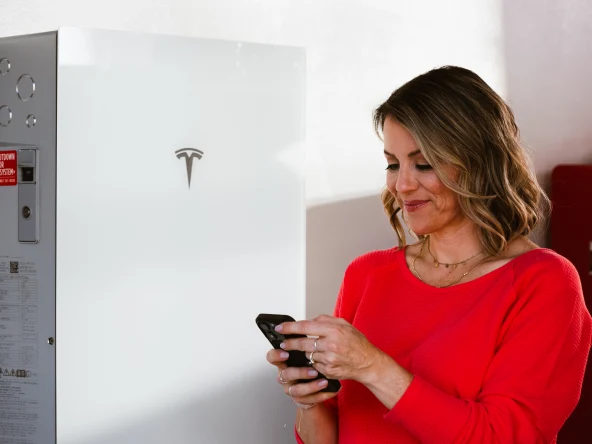
Lithium-ion batteries use the same proven technology that powers your smartphone and electric car, just scaled up for your home.1 These batteries live in a sleek, wall-mounted box. During sunlight hours, an inverter directs your excess solar power into the battery. When the sun sets, the system automatically switches gears and releases that stored energy to power your home.
You can watch all of this happen in real time through a solar smartphone app, though honestly, you'll probably check it once for fun and then forget about it because the system just works. Modern lithium-ion battery technology has proven its reliability and long lifespan.
Here's a bonus: lithium-ion batteries have a low self-discharge rate of around 1.5–2% per month, making them highly efficient for long-term storage in applications like renewable energy storage systems.5 This efficiency is crucial for homeowners who need reliable power daily.
Mechanical storage, thermal energy storage, and lead-acid batteries
You might hear about other storage options like pumped hydro, compressed air, flywheels, or thermal energy storage systems. Here's the thing: those are built for utilities and industrial sites, not homes. They need massive infrastructure, specific locations, or specialized facilities.
There are also liquid-based options like flow batteries and saltwater batteries, but again, those are for large-scale projects.
As for older lead-acid batteries? They were common in early solar systems but are heavy, less efficient, generate toxic waste, and are mostly phased out now.6 For your home, lithium-ion is the practical choice.
Picking the right storage solutions and backup power
Choosing a battery isn't about finding the biggest one on the market; it's about finding the right fit for your specific energy loads. Sizing is a balance between what you need to run and what you want to run. Smart planning of your battery capacity ensures you have power where it counts.
What battery size do I need?
What battery size do I need? Battery size depends on your average power draw during use and desired hours of coverage. A simple starting formula is: average kilowatts needed × hours of coverage = minimum battery capacity in kWh (before adjustments for efficiency, depth of discharge, and safety margins).
Most homeowners don't need to back up every single outlet and appliance during an outage. Focusing on critical loads maximizes the duration of your backup power and reduces the battery capacity you need to purchase.
Here's a breakdown of what typical battery capacity sizes can support:
5 kWh (Essentials): Covers critical loads like your refrigerator, Wi-Fi, a few lights, and phone charging. Duration depends on consumption patterns but typically supports 4–6 hours of essential use.
10 kWh (Standard): Recommended for households with 15–25 kWh daily energy use; keeps essentials running plus kitchen outlets, TV, and moderate A/C usage for extended periods.
15 kWh (Whole home): Supports most household circuits and larger A/C units, recommended for households with 25+ kWh daily energy use and 5+ people. Can provide substantial backup during outages lasting 12+ hours, depending on consumption.
How long can solar energy stored in a battery last?
Modern lithium-ion solar batteries can hold their charge for several days to weeks with minimal self-discharge loss. However, in typical home applications, batteries cycle daily, storing excess solar production during the day and discharging it during evening and nighttime hours.
Once charged, a lithium-ion battery is excellent at holding onto that stored energy. If you were to charge a battery and leave it alone, it could retain energy for several days with minimal loss. In a practical home scenario, you aren't storing power for weeks; rather, you're cycling stored solar energy to meet daily needs.
Is storing solar energy expensive?
Let's talk money. Battery storage is an investment, no question. But here's the good news: the cost of lithium-ion batteries has fallen by over 89% since 2010, largely due to improved manufacturing and economies of scale.7 The market for home batteries has matured significantly, driving down prices while improving technology.
Even better? You rarely have to pay the full amount upfront. You've got options that fit different financial situations:
Lease/PPA (Power Purchase Agreement): This is a popular model for those looking into the cost of solar without the burden of ownership. You pay a predictable monthly rate for the solar + storage system, while Sunrun retains ownership and handles all maintenance.
Cash: Requires the highest upfront investment, but gives you full ownership of the system, with no ongoing payments or contract terms to manage.
Key Insight: The high upfront cost of storage is optional. With "solar-as-a-service" models (PPAs), you can install a full battery system for $0 down, paying only a predictable monthly rate for the generated electricity.
What are the best solar battery storage solutions?
Choosing the right solar battery type in today’s market depends on your energy needs, home size, and backup goals. Here are some of the top residential options:
Tesla Powerwall
The industry-leading Tesla Powerwall offers reliable backup power and intelligent energy management for your home.
13.5 kWh storage capacity
Automatically detects grid outages
Multiple units can be stacked together for increased energy storage
Mobile app allows real-time monitoring and control of energy usage
Lunar Home Battery
The Lunar Home Battery delivers exceptional capacity with smart optimization technology and energy efficiency for California homes in the Bay area.
20 kWh storage capacity
Automatically optimizes power flows based on utility rates and grid status
Award-winning design recognized with iF International Design Awards
9.6 kW continuous output with 15 kW peak power for extended backup
Why choose Sunrun for solar panels and a battery?
Since 2007, Sunrun has served over 1 million U.S. homes. We customize every solar energy system to your power needs, roof characteristics, and usage patterns. Whether you need backup for essentials or whole-home independence. Our team delivers a right-sized solar + storage plan with zero guesswork for you.
Flexible payment
Flexible payment options range from $0-down solar plan subscriptions to full ownership. Access to sustainable energy shouldn't require cash up front.
24/7 system monitoring
If you avail our solar subscription plans, we provide continuous, round-the-clock monitoring for you. This proactive oversight helps detect issues early and supports reliable system performance over the long term.
Free maintenance and repairs
With a Sunrun subscription plan, you’re covered with a 25-year repair and workmanship warranty, plus proactive maintenance. We handle repairs. You're not figuring it out alone.
Solar performance guarantee
We guarantee your system will produce the energy we promise. If it underperforms, we'll make it right. You get predictable bills and reliable performance, backed by the industry's most experienced residential solar provider.
Maximize solar power with smart energy storage
The energy landscape is shifting fast. Rates are bouncing around, the weather's getting less predictable, and electricity demand keeps climbing. Learning how to store solar energy is one of the smartest ways to navigate this new reality.
With a battery, you store sunshine from bright and cloudy days for nighttime use, dodge rate spikes, and take control of your energy instead of being at the grid's mercy. It's a proactive step toward a more secure, resilient home.
Thinking about adding a battery for your new system? Request a quote now, and let’s chat about one that fits your home and budget.
Sources
1. https://www.energy.gov/eere/solar/solar-integration-solar-energy-and-storage-basics
2. https://www.energy.gov/eere/solar/solar-integration-inverters-and-grid-services-basics
4. https://www.eia.gov/todayinenergy/detail.php
5. https://www.cei.washington.edu/research/energy-storage/lithium-ion-battery/
6. https://www.adb.org/sites/default/files/linked-documents/43207-013-phi-oth-08.pdf
8. https://www.energy.gov/eere/solar/articles/solar-investment-tax-credit-what-changed